- Home
- Tips
- SAP career
Starting an SAP career: a field guide for career changers
What SAP work really is, how to get in and how to grow, with a deep dive into SAP FICO.
Why people are looking at SAP now
- 2027SAP ECC leaves mainstream maintenance. Extended maintenance runs to 2030.
- 37%of ECC customers had licensed S/4HANA by September 2024 (Gartner).
- 90+ daysto fill specialised and senior SAP roles in Europe (Eursap).
- 6,500people SAP plans to train in Brazil in 2026 through Future Talent.
Sources: The RegisterIT BriefBaguete
Overview
What this guide covers, and who it is for
About this guide
SAP runs the finance, supply chain and payroll of companies all over the world, and the people who set it up are SAP consultants. This guide explains what the work really is, where to learn it the legitimate way, how certification works in 2026 and what separates good consultants from the rest.
The short version: the market wants experience. This guide is about how to start building it.
Who it is for
- Finance, tax, logistics and IT professionals thinking of a move into SAP
- Recent graduates looking for a way in
- SAP key users who want to become consultants
- Consultants in other modules curious about FICO
How it is organized
Part 1, any module: the job, the market, the world map, ways in, the career ladder, a 12-month plan, certification and good habits.
Part 2, FICO: the FICO map, what S/4HANA changed, certifications and pay.
Part 3, reference: questions, myths and the bookmarks consultants keep open.
The job
What an SAP consultant actually does
SAP S/4HANA is an ERP: one system where sales, purchasing, production, finance and HR all post into the same database. A consultant learns how a company works and makes the system do it, mostly through configuration (in SAP called Customizing), and by writing specifications for developers when configuration is not enough. There are three broad families of roles.
Functional
Speaks the language of the business. Runs workshops, maps processes, configures the system, tests and trains key users.
Often comes from: finance, accounting, purchasing, logistics, production, HR.
Technical
Speaks code and infrastructure. Builds extensions, reports and interfaces, and keeps the systems up, secure and upgraded.
Often comes from: software development, databases, infrastructure.
Cross-project
Keeps the project, the data and the people in order. Every implementation needs these roles, and they are a good door in.
Often comes from: project and process roles, audit, IT support.
Read more: SAP roadmapPFCGSAP GRC
Why now
Deadlines, demand and AI
Thousands of companies still run SAP ECC, the previous generation, and have to move to SAP S/4HANA. SAP has set the clock.
- 2027End of mainstream maintenance for SAP Business Suite 7, which includes ECC 6.0. SAP says the date is unchanged.
- 2030End of extended maintenance, which customers pay a premium for.
- 2031–2033SAP ERP, private edition, transition option: a cloud subscription plus migration services for a few large customers on their way to RISE with SAP. SAP says it does not extend 2027 or 2030.
Source: The Register, January 2025
Europe · March 2026
The demand is for experience
Recruiter Eursap lists senior FI/CO, SD, MM and EWM functional consultants among the hardest roles to fill, next to S/4HANA programme managers, solution architects and Basis specialists. Employers ask for five to eight years of S/4HANA exposure, and senior SAP roles often take more than 90 days to fill.
For a newcomer: courses are not the bottleneck. The first project is.
IT Brief UKBrazil · 2025–2026
Brazil is training at scale
SAP trained more than 2,600 people through Future Talent in the first half of 2025 and plans 6,500 for 2026. The tech gap behind it: Brasscom counts just over 53,000 tech graduates a year in Brazil, against demand for about 150,000.
For a newcomer: in Latin America there is a free, official door in.
Baguete, August 2025AI · since 2025
AI changes the work, not the need
SAP’s Joule for Consultants draws on more than 9 TB of curated SAP knowledge, 3 million non-public documents and 250 million lines of ABAP. In early pilots it saved up to 1.5 hours per consultant per day and made delivery up to 14% faster.
For a newcomer: AI takes the searching and the boilerplate. Understanding the business and owning the decision stay with you.
SAP News, December 2025
World map
Where SAP runs, and where consultants are scarce
Two layers, two kinds of evidence: estimated counts of companies using SAP S/4HANA, and published reports of where consultants are hard to find. Switch between them.
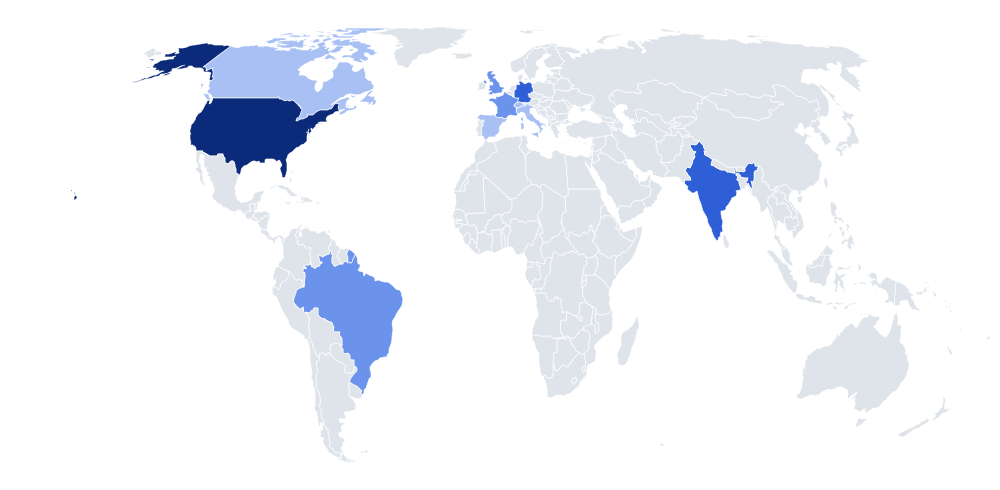
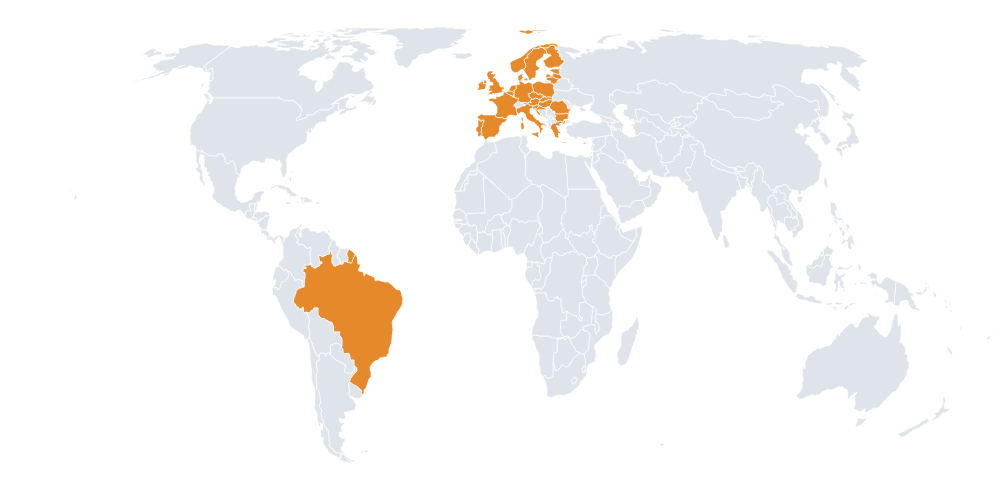
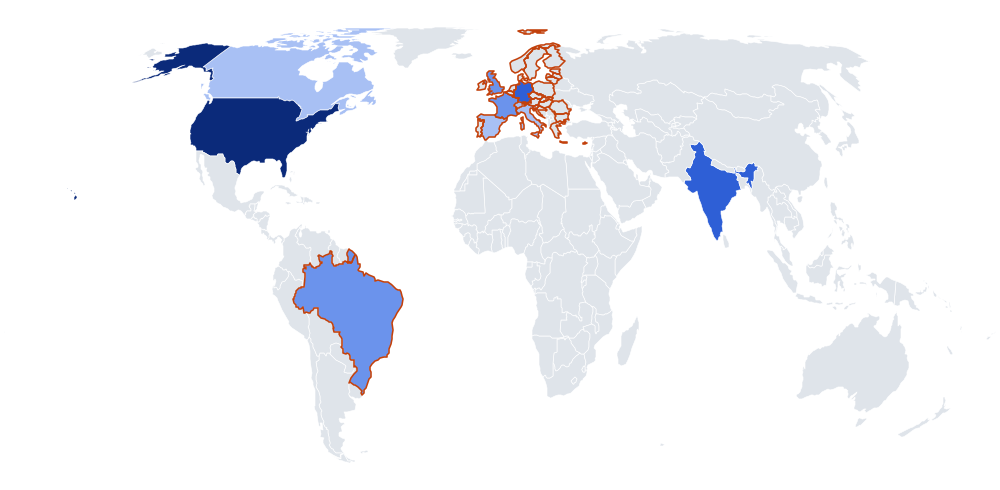
- 25% · United States
- 11% · India, Germany
- 4% · UK, Brazil, France
- 2–3% · Canada, Spain, Italy, Switzerland
- Outside the top 10
- Shortage documented in 2025–2026 reports
- No recent country data (not the same as no shortage)
- Orange outline: shortage documented
Top 10 countries
Companies using SAP S/4HANA, out of 53,025 detected worldwide.
- 1. United States13,355 · 25%
- 2. India6,091 · 11%
- 3. Germany5,849 · 11%
- 4. United Kingdom2,151 · 4%
- 5. Brazil2,117 · 4%
- 6. France1,889 · 4%
- 7. Canada1,388 · 3%
- 8. Spain1,219 · 2%
- 9. Italy1,138 · 2%
- 10. Switzerland1,033 · 2%
Source: Enlyft, updated 1 November 2026.
How to read it. The usage layer is an estimate from technographic data, not SAP’s customer list, and it counts the IT services firms that implement SAP as well as the companies that run it. Every country outside the top 10 has fewer companies than Switzerland’s 1,033. The shortage layer shows only where 2025–2026 reports document a shortage: we found them for Europe and Brazil, and no recent, comparable figures for the United States or Asia.
What the shortage reports say
Europe
Up to 100,000 SAP consultants short
Recruiter Eursap estimates a shortfall of up to 100,000 SAP consultants across Europe. FI/CO, EWM and IBP roles take the longest to fill.
IT Brief UK, January 2026United Kingdom
Visa rules tighten the market
The Skilled Worker visa salary threshold rose to £38,700. Fewer experienced SAP people move in from abroad, which raises competition and costs for senior roles.
IT Brief UK, January 2026Germany
The biggest hiring market
Europe’s largest SAP market by hiring volume, according to Eursap.
IT Brief UK, March 2026Nordics
Integration skills wanted
Strong demand for SAP BTP and integration specialists.
IT Brief UK, March 2026France and Benelux
Steady demand
Steady demand for SAP skills, mainly in manufacturing and logistics.
IT Brief UK, March 2026Southern Europe
Transformation is growing
More transformation work, with budgets deciding between permanent hires and interim staff.
IT Brief UK, March 2026Brazil
SAP is building capacity
SAP Brasil is working to raise the delivery capacity of its partners and plans to train 6,500 people in 2026. Brasscom counts just over 53,000 tech graduates a year against demand for about 150,000.
Baguete, August 2025
Your way in
Where you start decides where you fit
Nobody enters SAP from zero. What you did before is your advantage, so pick the background closest to yours.
Accountant or finance analyst
FI · Financial AccountingTypical first role
Key user in an SAP finance team, or junior FI consultant at an SAP partner.
Your edge
You already know debits and credits, accruals, reconciliations and the month-end close. That is the part of FI that takes longest to teach.
First three steps
- Take the free learning journey Implementing Financial Accounting in SAP S/4HANA on SAP Learning.
- Follow one supplier invoice all the way: posting, payment run, bank statement, closing.
- Learn how the Universal Journal keeps every posting in one table.
Watch out
Do not stop at running transactions. Consultants are hired for the configuration behind them.
Controller or cost accountant
CO · ControllingTypical first role
Analyst in a controlling team that uses SAP, then CO consultant.
Your edge
You understand overhead allocation, standard costs and variances: the logic behind cost centers and product costing.
First three steps
- Study cost centers and internal orders first, then product cost planning (SAP courses S4F22 and S4F23).
- Follow a production order from release to settlement and variance.
- Learn how margin analysis builds profitability reports.
Watch out
CO depends on logistics data. Learn the basics of PP (bills of material, routings) and of material valuation in MM.
Tax analyst in Brazil
FI + Brazil localizationTypical first role
Tax key user or tax analyst on an SAP project, then FI consultant with localization.
Your edge
Brazilian tax rules are among the most complex anywhere, and people who understand both the law and SAP are rare. The consumption tax reform (CBS and IBS) has a transition that runs to 2033.
First three steps
- Learn how SAP calculates Brazilian taxes and issues the nota fiscal.
- Understand SPED: which file comes from which SAP data.
- Follow what the tax reform changes in SAP.
Watch out
Tax knowledge without FI basics keeps you in support roles. Learn the general ledger too.
Read next: Brazil localizationBrazil taxationTax reform
Purchasing, sales or logistics
MM · SD · EWMTypical first role
Key user in purchasing, sales or the warehouse, then logistics consultant.
Your edge
You know how orders, goods and invoices really move, including the exceptions nobody documents.
First three steps
- Take the learning journeys for sourcing and procurement or for sales in SAP S/4HANA.
- Learn the end-to-end flows: procure-to-pay and order-to-cash.
- Learn where each logistics step posts in finance.
Watch out
Every goods movement and invoice lands in finance. Consultants who understand that side solve problems faster.
Read next: Learning journeysSAP FioriSAP roadmap
Developer or IT professional
ABAP · BTP · Integration · BasisTypical first role
Junior ABAP or integration developer, or Basis administrator.
Your edge
Coding, databases and infrastructure transfer directly. Modern ABAP (ABAP Cloud) and SAP Business Technology Platform are where extensions are built today.
First three steps
- Learn ABAP and the clean-core rules for extending S/4HANA.
- Explore SAP Business Technology Platform with the free learning journeys.
- Browse the APIs on the SAP Business Accelerator Hub.
Watch out
Learn the business process behind the code. It is what separates a developer from a consultant.
Read next: SAP ABAPSAP BasisSAP programs
Recent graduate
Any module, through an entry programTypical first role
Trainee or junior consultant at an SAP partner or consultancy, often in support.
Your edge
Time to study and no habits to unlearn.
First three steps
- Finish a free learning journey in the module closest to your degree.
- In Brazil or Latin America, apply to SAP Future Talent.
- Earn one certification and show on LinkedIn what you configured, not only the badge.
Watch out
Expect to start in support (AMS). It is where you see hundreds of real problems in a short time.
Read next: Future Talent bootcampsSAP certificationsLearning journeys
Already an SAP key user
The module you use every dayTypical first role
Analyst in the internal SAP team, then project consultant. The most common route of all.
Your edge
You know the real process, the real data and the people. Projects need that from day one.
First three steps
- Ask to join the next rollout, upgrade or migration as a key user.
- Learn the Customizing (SPRO) behind the transactions you run.
- Get certified to make your experience official.
Watch out
Tell your manager you want the move. Projects look for key users, and that is your door in.
Read next: SAP roadmapSE16HSAP OSS Notes
Career ladder
Reading job ads: one rule per level
SAP job ads ask for everything at once. Keep these rules in mind and you will know what each level really expects.
- Interns do not need experience.
- Junior consultants do not master processes.
- Consultants do not manage teams.
- Senior consultants do not make strategic decisions.
Level 1
Intern
“Interns do not need experience.”
What you do
- Documentation and test evidence
- Master data and data-load preparation
- Shadowing workshops and taking notes
Not expected yet
Configuring alone or taking decisions with the client.
How to move up
Learn one process end to end and earn a first certification.
Level 2
Junior consultant
“Junior consultants do not master processes.”
What you do
- Configuration under guidance
- Writing and running test scripts
- First-level support for users
Not expected yet
Designing solutions or leading workshops.
How to move up
Own one sub-area, such as asset accounting, from design to go-live.
Level 3
Consultant
“Consultants do not manage teams.”
What you do
- Running workshops and designing a module area
- Configuration and functional specifications
- Integration and user tests for the area, and go-live support
Not expected yet
Managing people.
How to move up
More go-lives, cross-module knowledge and coaching juniors.
Level 4
Senior consultant
“Senior consultants do not make strategic decisions.”
What you do
- Leading a module stream
- Solving cross-module issues
- Owning the quality of the stream and mentoring
Not expected yet
Setting the program strategy or the architecture alone.
How to move up
See the whole landscape: deployment options, roadmaps, costs and risks.
Level 5
Solution architect or lead
“Architects and leads make the strategic decisions.”
What you do
- Designing the end-to-end solution
- Choosing between standard, extension and partner products
- Balancing scope, cost and risk with executives
Not expected yet
Doing everything themselves: they rely on the team below.
How to move up
Program leadership or advisory roles.
This fifth level is our addition to the four rules above.
A plan
Twelve months, five moves
A sequence that works for most career changers. Your pace will differ; the order matters more than the dates.
Months 1–2
Foundations
Learn what an ERP is and how a company’s processes connect: order-to-cash, procure-to-pay, record-to-report. Everything you need to start is free on SAP Learning.
- Free learning journeys by role and product on SAP Learning.
- SAP Expert Lectures: the former openSAP courses, moved to SAP Learning in 2024.
- For FICO, refresh accounting first: double entry, accruals, reconciliations, closing.
Months 2–4
Hands-on
Reading is not enough: you learn SAP by configuring it. There are three legitimate ways to get a system.
- Practice systems in the SAP Learning Hub.
- 10 hours of practice systems included in the SAP certification exam package.
- The SAP S/4HANA fully-activated appliance on SAP Cloud Appliance Library: a 30-day test license, while you pay your cloud provider a few dollars per hour of running time.
Avoid
Pirated systems and sellers of “IDES access”: they are illegal, usually outdated, and nothing you learn there counts on a CV.
Links: SAP Cloud Appliance LibraryAbout the trial system (SAP PRESS)
Months 4–6
Certification
Pick one certification in your target module and prepare with its official learning journey. The FI exam (C_TS4FI) is a 3-hour assessment in a live system with a 60% passing score.
- Read the exam page first: topics and weightings tell you where to spend your time.
- Exam package: USD 276, two attempts and 10 hours of practice systems.
- You need an SAP Universal ID with two e-mail addresses to book the exam.
Months 5–9
Visibility
Make your learning visible. Recruiters search LinkedIn by module and by what you have done, not only by badges.
- Describe what you configured and tested, with the S/4HANA release.
- Join SAP Community: follow your module, ask, and later answer questions.
- In Brazil and Latin America, join SAP Future Talent: in 2025 its free bootcamps ran 16 hours each, live in the evening, and participants’ CVs went into a portal that SAP partners search.
Months 6–12
First role
Aim where newcomers are actually hired, and say yes to the work others avoid. It teaches the system fastest.
- Support teams (AMS) at SAP partners and consultancies.
- Internal SAP teams at your current employer: key user to analyst.
- Testing, data migration and hypercare on a project.
Links: Career ladderSAP roadmap
Certification
Certification in 2026: from multiple choice to a live system
Since November 2025 SAP has been moving its exams to practical, open-book tasks in real SAP systems, running them alongside proctored multiple-choice exams through 2026. The financial accounting exam shows how much has changed in five years.
| Financial accounting exam | Then: C_TS4FI_2021 | Now: C_TS4FI |
|---|---|---|
| Name | SAP Certified Application Associate – SAP S/4HANA for Financial Accounting Associates | SAP Certified – SAP S/4HANA Cloud Private Edition, Financial Accounting |
| Format | 80 multiple-choice questions | One system-based assessment: you do the work in a live SAP system |
| Duration | 180 minutes | 3 hours |
| Passing score | 63% | 60% |
| Languages | Seven, Portuguese included | English only |
| How you pay | One attempt, £175 plus taxes in the UK | Exam package at USD 276 a year: two attempts and 10 hours of practice systems. Or the SAP Learning Hub, which includes four attempts |
| Staying valid | Check SAP’s validity list for your release | 12 months, renewed through stay-certified assessments in the Learning Hub, with a 90-day renewal window |
Then: this site’s 2021 training page. Now, checked in November 2026: SAP Learning (C_TS4FI)sap.comSAP Learning help center
Cheapest start
Exam package
USD 276 for a 12-month contract: two exam attempts (two subjects, or one retake) and 10 hours of hands-on practice systems. Stay-certified assessments are not included.
Most complete
SAP Learning Hub
Annual subscription with four exam attempts, live sessions with experts, practice systems and the yearly stay-certified assessments. The price is on SAP’s site and varies by region.
Free
Learning journeys
Most of the study content for the exam is free on SAP Learning. For FI, the recommended path is the learning journey Implementing Financial Accounting in SAP S/4HANA.
From experience
SAP has had three certification levels: associate, specialist and professional. You can pass an associate exam by studying SAP’s material; the others need the kind of depth that only comes after years on projects. Do not worry about it: most consultants hold only associate certificates, including many with fifteen years of experience.
A sign of the times
Until 29 October 2026 the FI exam included a beta of Joule for Consultants, SAP’s AI assistant, as an open-book resource. SAP is testing what consultants can do with AI at their side, not just what they remember.
Is it worth it?
Yes, as a door opener. It gets your CV past filters, proves you studied the official content and gives you a structured way to learn a module.
No, as a substitute for experience. Hiring managers ask what you configured and which problems you solved. Pair the badge with practice and an entry route.
Good habits
What makes a consultant good: a self-check
Technical knowledge gets you on a project. These habits decide whether clients ask for you again. Tap the ones you already practise.
FICO deep dive
Why FICO is a good bet
Every company that runs SAP posts to finance. Sales, purchases, production and payroll all end in the general ledger, which makes FICO the module that touches all the others, and one that every SAP project needs. FICO is two modules that work as one.
FI · Financial Accounting
The outside view
Legal books, taxes, the balance sheet and the income statement, for tax authorities, auditors and investors.
CO · Controlling
The inside view
Costs, product costs, margins and performance, for the managers who run the business.
The FICO map
Pick a component to see what it does, how it connects and the transactions you will meet first.
FI · Financial Accounting
General Ledger
The heart of FI: the chart of accounts, journal entries, balances and financial statements. In S/4HANA every line lands in the Universal Journal.
How it connects
Receives postings from every other module: logistics, assets, payroll, controlling.
First transactions
FS00FB50FAGLL03H
FI · Financial Accounting
Accounts Payable
Supplier invoices, down payments and the automatic payment run.
How it connects
Invoice verification in MM (MIRO) posts the supplier invoice here; the payment run hands files to the bank.
First transactions
FB60MIROF110FBL1H
FI · Financial Accounting
Accounts Receivable
Customer invoices, incoming payments, dunning and credit control.
How it connects
Billing in SD creates the customer item here; bank statements clear it.
First transactions
FB70F-28F150FBL5H
FI · Financial Accounting
Asset Accounting
Fixed assets from acquisition to depreciation and retirement, with one valuation per accounting principle.
How it connects
Purchases can post straight to an asset; projects and investment orders settle to assets.
First transactions
AS01AW01NAFAB
FI · Financial Accounting
Bank Accounting
House banks, bank accounts, electronic bank statements and cash positions.
How it connects
Receives the payment run output and clears open items with the statement.
First transactions
FI12_HBANKFF67FEBAN
FI · Financial Accounting
Tax
Tax codes, tax calculation and tax reporting. In Brazil the localization adds the nota fiscal, SPED files and the tax reform.
How it connects
Every sales and purchase document carries a tax code that drives the tax postings.
First transactions
FTXPJ1BTAX
CO · Controlling
Cost Center Accounting
Where overhead costs are planned, collected and allocated to the areas that use them.
How it connects
Payroll, purchases and depreciation post costs to cost centers; allocations pass them on.
First transactions
KS01KSB1KSU5
CO · Controlling
Internal Orders
Cost collectors for events, campaigns or small investments, settled at period end.
How it connects
Collect costs from FI and MM, then settle to cost centers, assets or G/L accounts.
First transactions
KO01KOB1KO88
CO · Controlling
Product Costing
Standard costs of products, the costs of production orders and the variances between them.
How it connects
Built on PP master data (bills of material, routings) and feeds inventory valuation.
First transactions
CK11NCK24KKS2
CO · Controlling
Margin Analysis
Profitability by customer, product, region or channel, account-based in S/4HANA.
How it connects
Billing in SD and the cost of goods sold feed the market segments.
First transactions
KE30KE24
CO · Controlling
Profit Center Accounting
Results by area of responsibility. In S/4HANA the profit center is a field on every Universal Journal line.
How it connects
Derived from cost centers, materials and orders, so every posting knows its profit center.
First transactions
KE51KE5Z
CO · Controlling
Material Ledger
Inventory valuation in several currencies and valuations, and actual costing where it is switched on.
How it connects
Every goods movement updates it; the period-end actual costing run revalues inventory.
First transactions
CKM3CKMLCPCKMDUVMAT
Where FICO meets the rest
Most FICO problems start in another module. Knowing these five crossings is what makes a FICO consultant useful on day one.
- MM → FIGoods receipts and supplier invoices post through automatic account determination (
OBYC). - SD → FI/COBilling posts revenue through its own account determination and feeds margin analysis (
VKOA). - PP → COProduction orders collect costs; variances settle at period end.
- PS → COProjects carry costs and settle them to assets, cost centers or the income statement.
- HR → FI/COPayroll posts to the general ledger and to cost centers.
FICO in S/4HANA
Six changes to learn first if you studied ECC
Many courses, books and forum answers still describe SAP ECC. These are the S/4HANA differences that trip up newcomers in interviews.
- 01
One table: the Universal Journal
FI, CO, asset accounting and material ledger line items live in one table, ACDOCA. Reconciling FI with CO is mostly a thing of the past.
Universal Journal - 02
Cost elements are G/L accounts
You create them in FS00 with a cost element category. The separate cost element master of ECC is gone.
Finance in SAP - 03
Business partner for everyone
Customers and suppliers are maintained as business partners in transaction BP, not in the old separate masters.
- 04
New Asset Accounting
The new asset accounting is the only option, posting every valuation, such as local GAAP and IFRS, in real time.
Asset accounting - 05
Margin analysis
Account-based profitability analysis, now called margin analysis, is SAP’s recommended way to report profitability, straight from the Universal Journal.
- 06
Material ledger is always on
Inventory valuation runs through the material ledger in S/4HANA; actual costing remains optional.
Material ledger
FICO path
FICO certifications, pay and the Brazilian edge
| Code | Certification | What it covers |
|---|---|---|
C_TS4FI | SAP Certified – SAP S/4HANA Cloud Private Edition, Financial Accounting | 3-hour system-based assessment, 60% to pass. Accounts payable weighs most (21–30%), then document types (11–20%); accounts receivable, the payment run, asset accounting, a new company code and the general ledger up to 10% each. |
C_TS4CO | SAP Certified – SAP S/4HANA Cloud Private Edition, Management Accounting | Cost centers and internal orders (S4F22), product cost planning (S4F23), cost object controlling (S4F25), profit center accounting (S4F28) and profitability analysis (S4F29). |
C_S4CFI | SAP Certified – Implementation Consultant – SAP S/4HANA Cloud Public Edition, Financial Accounting | The same ground for the public cloud edition, where companies adopt SAP’s standard processes with little room for custom configuration. |
Sources: SAP Learning pages for C_TS4FI and C_TS4CO; ERPPrep for C_S4CFI (not affiliated with SAP).
Which one first?
Start with FI if you come from accounting, with CO if you come from costing or controlling. Projects hire “FICO” consultants who handle both, so plan the second one once you have your first project.
The Brazilian edge
In Brazil, FI plus localization is what sets consultants apart: tax codes, the nota fiscal, SPED and now the consumption tax reform, whose transition runs to 2033.
What experienced FICO consultants earn
- £625 a dayMedian UK contract rate for SAP FI/CO consultants in the six months to 5 November 2026, up from £575 a year earlier (21 adverts).ITJobsWatch
- $138k a yearAverage US base salary of senior SAP consultants with FICO skills, from 66 profiles (updated May 2025).PayScale
- By the hourIn Brazil and the US, senior consultants often work as contractors billed per hour; in the UK, contracts are usually priced per day. Rates depend on module, localization depth and client.
These are figures for experienced consultants, not entry salaries.
Want to see a FICO consultant’s busiest days? Read Period-end closing, then Product costing for the CO side.
The questions career changers ask most
Do I need to know programming to work with SAP?
No, not for functional roles such as FI, CO, MM or SD. You configure the system, you do not code it. Reading tables helps a lot (see SE16H), and basic SQL never hurts. ABAP is for technical roles.
Do I need an accounting degree to become a FICO consultant?
It is not required, but you need accounting logic: double entry, accruals, reconciliations, the month-end close. Accountants have a head start. Everyone else should learn those basics before the SAP side.
Is a certification enough to get a job?
It opens doors and gets your CV past filters, but hiring managers look for experience. Combine it with hands-on practice, a network and one of the entry routes for your background.
Which module should I choose?
The one closest to what you already know. A module you understand beats a fashionable one. Finance and controlling are a safe choice because every SAP company needs them: recruiters list senior FI/CO consultants among the hardest roles to fill.
Should I learn ECC or S/4HANA?
S/4HANA. New implementations and migrations are S/4HANA. Knowing ECC helps in conversion projects, where you will meet both, so learn the big differences: the Universal Journal, cost elements as G/L accounts, the business partner, new asset accounting, margin analysis and the material ledger.
Is it too late, with ECC maintenance ending in 2027?
No. Mainstream maintenance ends in 2027, extended maintenance runs to 2030 and a transition option goes to 2033. After a migration, S/4HANA systems still need support, upgrades and changes for new laws, such as Brazil’s tax reform.
Will AI replace SAP consultants?
SAP positions Joule for Consultants as an assistant: in its pilots it saved time on searching and routine tasks. The routine part of the job shrinks; understanding the business, designing the solution and taking responsibility do not. Learn to use these tools well.
Can I practise without working for a company that has SAP?
Yes, legally. The SAP Learning Hub includes practice systems; the exam package includes 10 hours of them; and SAP Cloud Appliance Library deploys an S/4HANA trial with a 30-day test license on your own cloud account, where you pay the provider a few dollars per hour while it runs.
Is it worth paying for a bootcamp or a private course?
Use the free options first: learning journeys and, in Latin America, SAP Future Talent. If you pay, prefer SAP education partners, ask whether you get real system access, and remember that a school’s own certificate is not an SAP certification.
Can I change careers at 35, 40 or later?
Yes. Many consultants came from finance, logistics or operations, and that business experience is exactly what functional roles need. The key-user route values it most.
Can I work remotely or abroad?
Many SAP projects are international and run remotely or hybrid, and contract work is common for experienced consultants. English is essential, and working in another country still depends on its work permits and tax rules.
Can I put training as “SAP experience” on my CV?
No. List courses, practice and certifications as what they are. Invented experience falls apart in the first technical interview, and the SAP market is small: reputations travel.
Myths
Six things people believe about an SAP career
Myth
SAP is a job for programmers.FactMost SAP roles are functional: they configure business processes. ABAP is one path among many.
Myth
A certificate gets you hired.FactIt gets you noticed. Experience gets you hired, which is why your entry route matters as much as the exam.
Myth
ECC ends in 2027, so SAP work ends too.FactMainstream maintenance ends in 2027, extended maintenance in 2030, and a transition option runs to 2033. S/4HANA systems keep needing people.
Myth
AI will do the configuration.FactSAP sells its AI for consultants as a time saver for routine work. Design, decisions and accountability stay human.
Myth
You need a pirated system to practise.FactUse SAP’s practice systems (Learning Hub or the exam package) or the 30-day trial appliance on SAP Cloud Appliance Library.
Myth
FICO is just accounting.FactFICO sits at the crossroads: purchasing, sales, production and payroll all post into finance. Integration is the job.
Bookmarks
The links every SAP consultant keeps open
Official SAP sites first. Some ask for a free SAP Universal ID; SAP Notes and the support tools need an S-user from a customer or partner.
- Learn and certifySAP LearningFree learning journeys, live sessions and the certification hub.learning.sap.com
- Learn and certifyLearning journeysSelf-paced paths by role and product, free to follow.learning.sap.com
- Learn and certifySAP certificationsEvery current exam with its topics, weightings and format.learning.sap.com
- Learn and certifySAP Expert LecturesThe former openSAP courses, now on SAP Learning.learning.sap.com
- Learn and certifySAP Learning HubPaid subscription: exam attempts, live sessions, practice systems.www.sap.com
- Learn and certifyBuy an SAP examThe exam package: two attempts and 10 hours of practice systems.www.sap.com
- Daily workSAP for MeSAP’s customer portal: Notes, incidents, systems and licenses.me.sap.com
- Daily workSAP Support PortalSearch SAP Notes and knowledge base articles (S-user needed).support.sap.com
- Daily workSAP Help PortalOfficial documentation for every product and release.help.sap.com
- Daily workSAP CommunityBlogs, questions and answers from SAP and consultants.community.sap.com
- Daily workSAP Fiori apps reference libraryFind the Fiori app behind a transaction, with its roles.fioriappslibrary.hana.ondemand.com
- Daily workSAP OSS Notes for FICOOur selection of the Notes FICO consultants use most.sapnfe.com
- Projects and upgradesSAP Signavio Process NavigatorSAP Best Practices processes; replaced Best Practices Explorer in 2023.me.sap.com
- Projects and upgradesSAP Road Map ExplorerWhat SAP has planned for each product.roadmaps.sap.com
- Projects and upgradesSimplification Item CatalogWhat changes from ECC to each S/4HANA release.launchpad.support.sap.com
- Projects and upgradesProduct Availability MatrixRelease dates, maintenance periods and supported platforms.support.sap.com
- Hands-on and APIsSAP Cloud Appliance LibraryDeploy trial systems, such as the S/4HANA appliance, on your cloud account.cal.sap.com
- Hands-on and APIsSAP Business Accelerator HubAPIs, events and integration content for SAP products.api.sap.com
- Hands-on and APIsSAP Discovery CenterBTP services, guided missions and the pricing estimator.discovery-center.cloud.sap
- Your accountSAP Universal IDOne login for SAP sites; certification needs it with two e-mails.account.sap.com
- Your accountSAP badges on CredlyVerify and share your SAP certification badges.www.credly.com
Related pages
References
Checked in November 2026. Prices, exam rules and rates change: check the official page before you buy. Third-party sites are marked as such.
- SAP Certification: exam packagesap.com
- Preparing for the exam: purchase options and staying certifiedlearning.sap.com
- C_TS4FI: SAP S/4HANA Cloud Private Edition, Financial Accountinglearning.sap.com
- Get Certified live session: Management Accounting (C_TS4CO)learning.sap.com
- openSAP moves to SAP Learningopen.sap.com
- Consulting in the age of AI: Joule for Consultants (Dec 2025)news.sap.com
- Future Talent expands to Brazil, Mexico and Colombia (Aug 2023)news.sap.com
- Future Talent free virtual bootcamps (May 2025)news.sap.com
- SAP Best Practices Explorer service ends (2023)community.sap.com
- Using the Simplification Item Cataloglearning.sap.com
- SAP extends support deadline, sort of (Jan 2025)The Register
- EU faces growing shortage of SAP S/4HANA specialists (Mar 2026)IT Brief UK
- Tighter visa rules deepen SAP S/4HANA skills shortage (Jan 2026)IT Brief UK
- Companies using SAP S/4HANA (updated 1 Nov 2026)Enlyft
- SAP quer acelerar formação de mão de obra em 2026 (Aug 2025)Baguete
- SAP FI/CO Consultant contracts, UKITJobsWatch
- Senior SAP Consultant with SAP FICO skills, USPayScale
- What to know about the SAP S/4HANA trial systemSAP PRESS blog
- C_S4CFI certification guide 2026ERPPrep, not affiliated with SAP
- Country shapes for the world map (public domain)Natural Earth